

That pushes us to look for effective ways to address this challenge, to save time, resources, and money all together.
But how?
We can’t ignore risks with limited visibility while juggling multiple priorities. Because success requires identifying and managing threats that could derail the project’s value delivery.
However, a Risk Register offers a structured way to identify, analyze, and respond to risks to ensure the best outcomes.
At its core, risk identification ensures that potential threats and opportunities are captured before they impact the project.
Identification is not simply about listing concerns, it is also about gathering diverse perspectives to uncover risks that might otherwise be missed.
By assembling stakeholders from different functions, organizations capture a comprehensive view of risks, avoid blind spots, and maintain proactive control over project outcomes.
Risks vary in significance and urgency. Risk analysis helps prioritize which risks demand immediate attention.
This practice ensures that teams focus on high-impact threats and that resources are allocated based on risk severity. The result is better decision-making, focused mitigation efforts, and improved project stability.
For every risk identified, assign scores for Probability and Impact. The formula is straightforward:
Probability (Likelihood) × Impact (Severity) = Risk Assessmen
By comparing risks side by side, leadership can allocate resources to the most critical items based on the project’s risk tolerance.
In this way, risk analysis acts as a filter that reduces noise and strengthens prioritization.
It is important to note that risks can represent opportunities as well. The team should manage both threats and opportunities with equal rigor.
Clear and decisive response planning is essential in risk management. By ensuring that each risk has a defined strategy, teams know exactly how to react when conditions change.
Response planning also reduces confusion by helping teams understand which risks to avoid, mitigate, transfer, or accept. The outcome is greater preparedness and faster response when risks materialize.
Note: Risks are typically reviewed using qualitative methods. However, in critical situations involving extreme cost, loss of life, or major schedule impacts, quantitative analysis is required. In these cases, additional resources may be necessary to assess risk exposure fully.
Engaging risk owners in the monitoring and response process leads to better accountability and stronger risk control.
When risks have designated owners, they are more likely to be tracked effectively and contribute to timely mitigation actions.
This accountability builds confidence in the risk management process and increases the likelihood of successful outcomes. The project Risk Manager is responsible for ensuring the Risk Register stays current and accurate.
In project environments, risks must adapt to changing conditions, team progress, and emerging information.
Risk management equips teams with the tools to reassess threats, update mitigation plans, and adjust strategies when needed.
This flexibility enables projects to respond quickly to new risks or opportunities, while maintaining team confidence that exposures are being managed appropriately.
A Risk Register is not a “one-and-done” document. It should be reviewed regularly during status meetings. New risks will emerge, and old ones will disappear as the project progresses.
If you are building this in Excel or a project management tool, your columns should include:
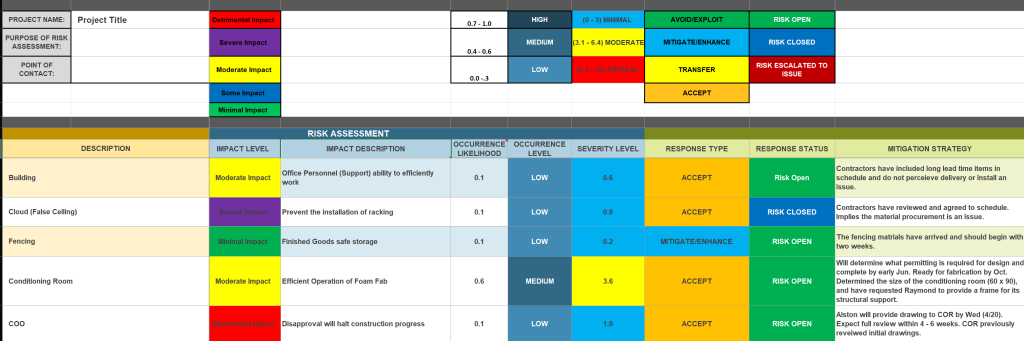
This structure captures Description, Impact Level, Probability, Severity, Response Type, Status, and Mitigation Strategy, making it easy for teams to track risks at a glance.
Risk management is more than just a tool for documenting threats. Basically it is a framework for achieving project resilience.
By identifying risks early, analyzing them systematically, planning responses, assigning ownership, and monitoring continuously, projects can focus on delivering maximum value.
These practices not only improve project success rates but also build confidence and preparedness, empowering teams to navigate uncertainty in an ever-changing environment.
PCS Corp is a Management Consulting firm that focuses on Portfolio/Project Management, Manufacturing & Systems Integration.